
Reviewing Wood Grain Scale and Direction in Furniture Renders
For a furniture render, grain scale and direction support the form when they reinforce the component proportions, visual axis, and room context. Review those cues before judging material realism. A polished surface can still hide an unresolved form.
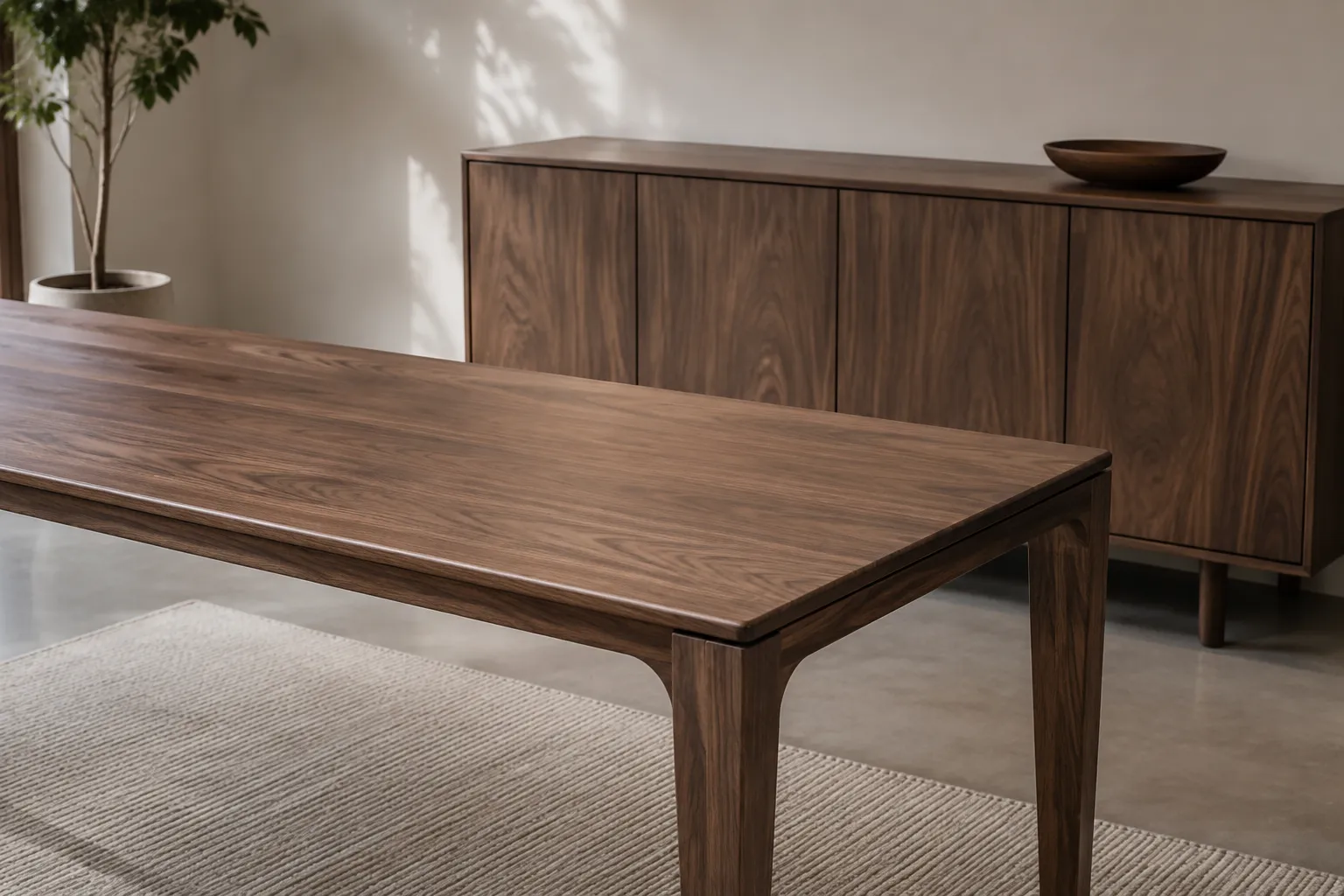
The render can show an apparent mismatch, such as oversized grain making a panel feel compressed or a direction change weakening the relationship between a top, edge, leg, drawer, or curved part. The brief should state the intended visual direction. A material sample, construction drawing, board-layout record, or mapping record may still be needed for confirmation.
Start With Form
Ask whether the grain helps the viewer read the furniture’s silhouette and component placement. Use the same camera and lighting when comparing alternatives.
- Does the direction support the longest dimension or intended visual axis?
- Does the pattern preserve the panel’s proportion?
- Does it remain coherent when the surface turns over an edge?
- Do related components appear to share a deliberate material direction?
- Does the grain compete with the silhouette, joinery, or contact points?
- Does the room context make the pattern appropriately quiet or active?
A long tabletop with short, enlarged grain marks may appear visually compressed. A cabinet front with strong vertical grain may read taller, even though its geometry has not changed. These are render-review observations, not conclusions about the actual board, species, or production method.
The render shows grain that appears too large for the tabletop proportion. Please provide a reduced-scale comparison before approving the material direction.
This approval note identifies the visible issue and the requested revision without treating the image as proof of a physical material choice.
Check Wood Grain Scale in the Render
Texture scale needs a known visual cue. Without a reference dimension, the judgment can shift from one view to another.
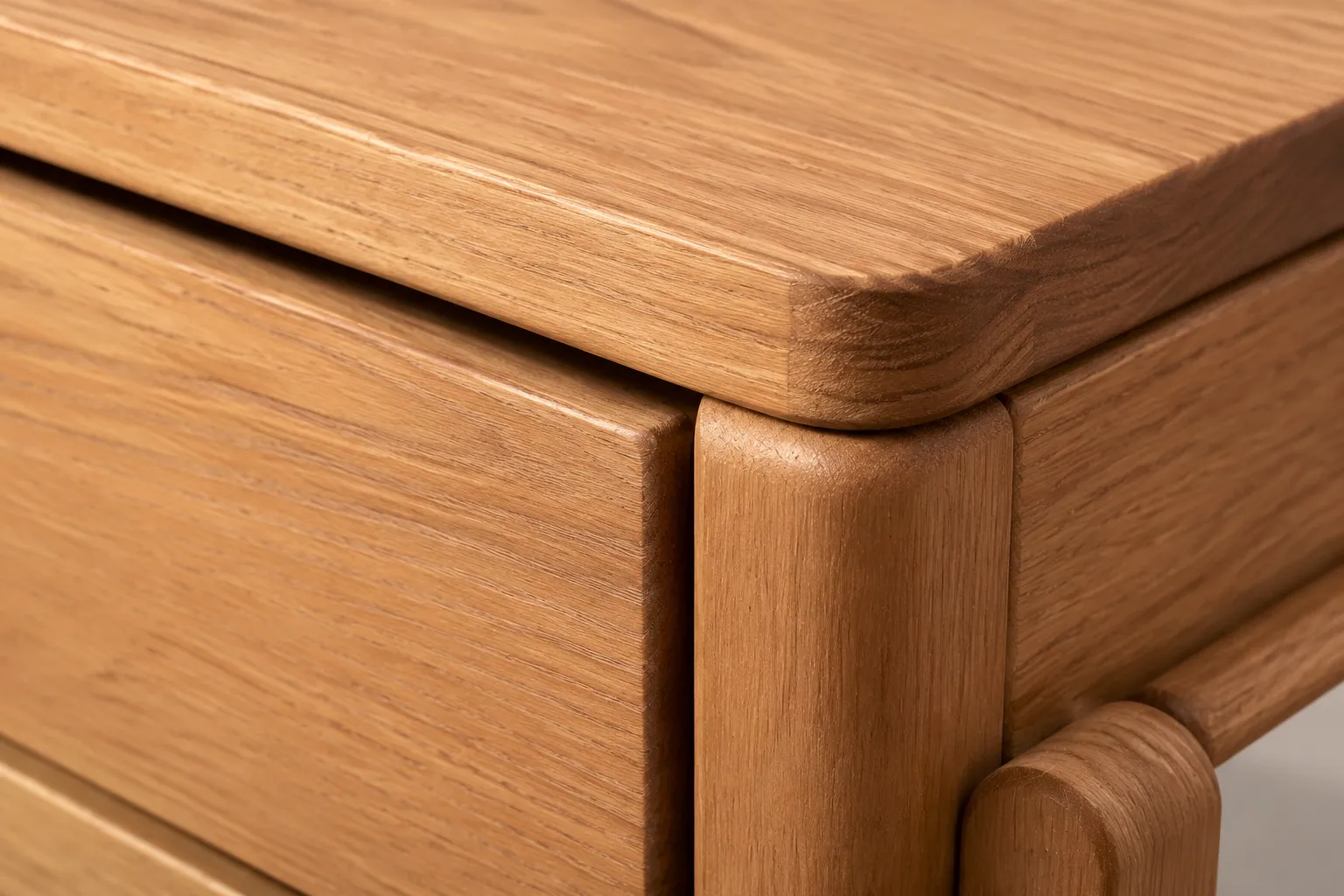
Choose a model component with a specified size, such as a drawer front, seat rail, tabletop, cabinet door, shelf thickness, leg, or stretcher. Compare the apparent grain spacing with that component’s proportion and with nearby room surfaces.
When the pattern may be too large
- A few grain bands dominate an entire panel.
- The surface reads as a graphic stripe rather than a material pattern.
- Small components display the same large marks as broad panels.
- The grain becomes the first cue before the silhouette is read.
- The same distinctive marks repeat across separate furniture pieces.
- The surface appears enlarged beside the floor, wall, or other known scale cues.
When the pattern may be too small
- The surface becomes uniformly noisy at the intended camera distance.
- The grain disappears where it should support component orientation.
- A close view lacks useful variation in color, roughness, or surface relief.
- The pattern no longer helps distinguish one component from another.
Controlled image studies have examined how grain contrast and pattern variation affect visual impressions. They can support review terms such as quiet, varied, repetitive, or high-contrast. They do not establish one preferred scale for every furniture type, species, finish, or audience.
Compare Grain Direction Across Components
Review wood grain direction against the form each component is meant to express. A useful comparison has two views: the current render and a controlled alternative with the proposed orientation changed.
Keep the camera, lighting, color, roughness, and other material variables as consistent as possible. If several variables change at once, the team cannot tell which adjustment affected the decision.
| Review point | Question to record |
|---|---|
| Primary plane | Does the direction support the main length, width, or visual axis? |
| Edge transition | Does the grain continue or change in a way that supports the intended form? |
| Secondary components | Do drawers, doors, shelves, and legs relate to the main plane? |
| Contact points | Does the direction draw attention toward or away from handles, joins, feet, or supports? |
| Curved surfaces | Does the pattern remain coherent as the surface bends? |
| Room context | Does the direction support the object’s placement in the interior? |
If the top runs horizontally while the front edge suddenly turns vertically, the render shows a continuity concern. The cause may be a mapping issue, or it may reflect an unresolved construction assumption. A mapping record can investigate the first possibility. A construction drawing or production reference is needed for the second.
Inspect Grain Continuity and Edge Response
Continuity matters where the eye expects related surfaces to connect: a tabletop and edge, a door and frame, neighboring drawer fronts, or a curved shell that appears to come from one form.
- A grain line stops abruptly at a visible corner.
- Adjacent parts use unrelated pattern centers without a stated reason.
- Repeated drawers show identical marks in identical positions.
- The direction changes between connected surfaces without a form cue.
- A curved part appears wrapped with a flat image.
- The edge response conflicts with the direction visible on the main plane.
Two-dimensional texture maps can distort or become inconsistent on three-dimensional and non-planar objects. Volumetric or procedural approaches may address some image-mapping problems, but their use does not confirm the physical structure of a particular furniture piece.
Edges often expose a visual mismatch before broad faces do. Inspect sharp tabletop edges, rounded corners, beveled fronts, turned legs, bent shells, thin exposed layers, and end-grain-like areas shown in the concept.
Directional highlights change with surface orientation, viewing angle, and the material setup. That mechanism helps explain why a surface can look inconsistent even when its color pattern seems plausible. It does not identify the actual cut, species, or finish system. The material sample and finish record remain necessary for physical confirmation.
Grain continuity is unresolved between the cabinet door and right stile. Please confirm the intended direction across the assembly, then issue a revised comparison view.
Compare the Render With the Brief
“Natural wood” or “visible grain” leaves too many review decisions open. The brief should identify the visual choices that affect approval.
- Intended grain direction for each primary component
- Whether adjacent parts should align visually
- Expected pattern scale at the review camera distance
- Whether the grain should remain quiet or act as a design feature
- Areas that require a close comparison
- Assumptions requiring a material or production handoff
A useful request might read:
Show two tabletop directions at the same camera angle. Keep the grain moderate in scale, align the long-axis reading with the top, and preserve a quieter pattern on the legs. Confirm the edge treatment against the material reference before approval.
This is a visual-direction request. It does not convert the render into a manufacturing specification.
Use the Room View as a Second Check
A surface can appear acceptable in isolation and distracting in a room. Surrounding light, floor direction, wall color, shadows, and nearby materials change how the grain is read.
- Does the grain compete with stronger architectural lines?
- Does the piece still read as one form at the intended distance?
- Does the surface appear more active than the brief allows?
- Does the room strengthen or soften the apparent contrast?
- Does the furniture sit coherently with surrounding materials?
- Does the direction support the object’s placement?
Research using computer-visualized interiors has discussed unity, repetition, reflection, scale, and room purpose together rather than treating wood as an isolated surface. That supports using the complete room image for review. It does not establish a universal audience response or predict commercial performance.
When to Request a Mapping Investigation
Request a mapping investigation when the problem is visible but its cause may sit in the three-dimensional material setup.
- Texture scale relative to model dimensions
- Texture orientation on each component
- Surface mapping continuity
- Projection changes across curved geometry
- Repetition or tiling
- Rotation and offsets between related parts
- Whether color, roughness, bump, and directional effects use compatible mapping
Software documentation can provide terminology for these controls and help the team describe where to investigate. It cannot establish wood performance or prove that the selected setup matches a production material.
Please inspect the texture scale and orientation on the top, front edge, and side panel. Include the mapping record with the next render so the source of the discontinuity can be reviewed.
Common Misreadings
“The grain looks realistic, so the direction is correct.”
Detail can still be oversized, misaligned, repetitive, or inconsistent across components. Judge it against the brief and the furniture form.
“The pattern identifies the species or cut.”
A render may show color variation, pores, grain direction, or directional highlights. Those cues do not establish species, cut, board selection, or finish system.
“More detail will solve the problem.”
Additional resolution can sharpen an unsuitable pattern. Revise scale, direction, or continuity when those are the criteria in question.
“The same texture can be used everywhere.”
Shared settings can create repetition or incorrect orientation. Related components may need separate placement records while retaining one finish direction.
“A close-up view is enough.”
A close view helps inspect grain and edge response. The room view remains necessary for proportion, visual activity, and surrounding material relationships.
What the Render Can Establish
The image can support a decision about visible communication. It can show apparent grain scale, direction, repetition, continuity, edge response under the chosen lighting, component relationships, room interaction, and competition with the intended form.
It leaves other questions unresolved: exact species or material identity, physical board layout, joinery and construction accuracy, finish behavior under real illumination, structural or electrical performance, durability, manufacturability, production readiness, and commercial response.
Use the render as evidence about the image. Use the material sample, drawing, production record, or qualified technical review for the decisions the image cannot establish.
Approval Note to Send
End the review with one observable issue, one requested change, and one unresolved dependency.
The render shows [visible issue] on [specific component]. Compare [current direction or scale] with [requested alternative] while keeping the camera and lighting consistent. The [material sample, construction drawing, board-layout record, or mapping record] is still needed to confirm [unresolved point].
For example:
- The render shows grain that is too dominant on the drawer fronts relative to the cabinet body. Please provide a reduced-scale comparison and confirm whether one direction is intended across the drawer set.
- The side panel appears to reverse direction at the rounded corner. Please inspect mapping continuity and confirm the intended construction direction against the approved material reference.
- The tabletop direction supports the long axis, but the room view makes the contrast too active beside the floor. Please issue a quieter finish variant for comparison; the render does not confirm the physical finish.
Record the decision when the team can state whether the current image supports the intended form, identify the exact revision if it does not, and name the missing record or qualified production review required before material or construction approval.
Sources
- Wood Handbook: Wood as an Engineering Material
- Blender Manual: Materials
- Simulating the structure and texture of solid wood
- Automatic inference of a anatomically meaningful solid wood texture from a single photograph
- Procedural wood textures
- Effect of image characteristics of edge-grain patterns on visual impressions
- Looking at computer-visualized interior wood: A qualitative assessment using focus groups